
Communicating Effectively with Thai Employees – Cultural Tips for Israeli Managers
Clear, respectful communication turns good teams into great ones. Here’s a practical playbook—shaped by our Thai–Israeli experience—to help your Thai staff feel confident, safe, and productive from day one.
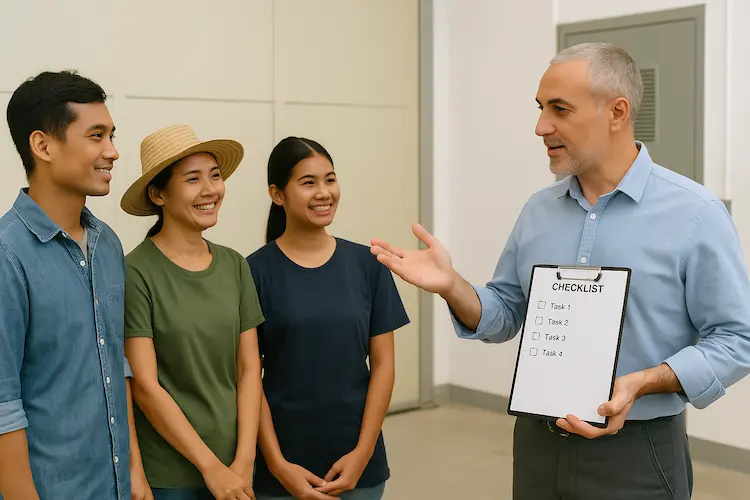
Why Culture Matters in Daily Operations
Thai and Israeli work styles complement each other. Israeli managers value directness and speed; Thai teams value harmony, respect, and consistency. When we blend both—clarity + respect—training sticks, safety improves, and turnover goes down.
Five Principles That Work
- Clarity over volume: Keep instructions short, step-by-step, and calm. Avoid raised voices—even when urgency is high.
- Respect saves time: A polite greeting and thanks go a long way. It builds trust and speeds up learning.
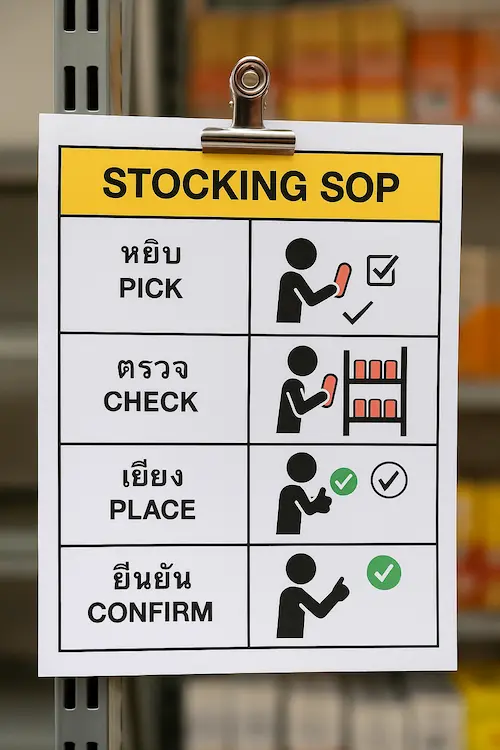
- Show, don’t only tell: Pair words with visual SOPs, checklists, and color codes.
- Private corrections, public praise: Deliver critical feedback 1:1; praise reliability in front of the team.
- Consistency wins: Repeat key messages the same way each shift; it reduces errors across rotations.
Practical Tools You Can Use This Week
1) Visual SOPs (Standard Operating Procedures)
- Use pictures + short verbs: “Pick → Scan → Place → Confirm”.
- Laminate A4 cards at each station; add color zones to match floor areas.
- Update after any process change—don’t rely on memory.
2) Daily 5-Minute Safety Huddles
- One message per day: PPE, lifting, wet floor, forklift path.
- Keep tone friendly; ask one worker to repeat the key point (confirmation, not a test).
3) Buddy System (Week 1–2)
- Pair each new worker with a reliable team member; give a simple checklist for Day 1–3.
- Manager checks in at the end of each shift: “Any questions? Anything unclear?”
4) Feedback in Three Steps
- Describe what you saw (no labels).
- Explain the impact (safety/quality/time).
- Show the correct step and ask for repeat-back.
5) Language Tips That Help Immediately
- Use simple English/Hebrew words with gestures: “Stop”, “Safe”, “Scan”, “Left/Right”.
- Numbers + times on paper/phone (08:00, 12:30) avoid misunderstandings.
- Avoid sarcasm or jokes during instructions; keep it literal and friendly.
Real Scenarios & How to Respond
“Yes, yes” but task not done
Why it happens: Politeness—saying “yes” to acknowledge, not to confirm understanding.
Fix: Ask for a repeat-back and point to the SOP card: “Please show me step 1–2–3.”
Hesitation to say “no”
Why: Avoiding confrontation is respectful in Thai culture.
Fix: Offer choices: “Option A or B?” or ask, “Which step is unclear?” to invite questions safely.
Rushing during peak hours
Fix: Pre-assign roles before the rush; use colored tags (Pick/Pack/Load) and a 30-second huddle.
Manager Communication Kit (Printable)
- Shift card: tasks, timings, who-to-ask-for-help
- Pictogram SOP for each station (A4 laminated)
- Daily huddle topic list (Mon–Fri)
- “Stop Work” phrase list (simple, polite, clear)
- Week-1 buddy checklist with sign-off
What You’ll See After 2–4 Weeks
- Fewer repeated questions; faster station handovers
- Cleaner audits and safer behavior on the floor
- Higher reliability and morale—especially around peak hours
These outcomes come from communication systems, not from pushing harder. Build the system once—then let it work for you.
Need Help Building Your Communication System?
ThaiToGo can create customized SOP cards, run on-site briefings for supervisors, and support bilingual onboarding tailored to supermarkets, warehouses, factories, car garages, and retail.
Talk to our team to start with a quick assessment call.
ข้อมูลสั้นสำหรับหัวหน้างานไทย–อิสราเอล 🇹🇭
สื่อสารให้ชัด สั้น และสุภาพ พร้อมภาพประกอบหรือบัตรขั้นตอนงาน (SOP) จะช่วยให้ทีมไทยทำงานได้ถูกต้องและเร็วขึ้น ThaiToGo สามารถช่วยจัดทำ SOP แบบสองภาษา อบรมหัวหน้างาน และดูแลการเริ่มงานช่วงแรก ดูรายละเอียดได้ที่หน้า ติดต่อเรา.